
FRUSTRAIN // TRAINMAN
Georgy Molodtsov
ViverseWebXR+1
Narrative world TRAINMAN and social lobby Waiting Hall accessible via WebXR, Desktop & Mobile simultaneously. A vertical slice and proof of concept for a bigger game, available to anyone online.
Editorially reviewed
An immersive spatial exploration game set in a haunting, human-free version of Hong Kong's SoHo and Central/West districts — reconstructed with photorealistic accuracy using SLAM-based 3D Gaussian Splatting. Players roam an eerily abandoned city surface where colourful street murals act as hidden portals into a sprawling underground dungeon network built with 3D World Models. Backed by VIVERSE (HTC) with support from XGRIDS, World Labs, and the Dell Pro Precision Ambassador Council. Build-in-public — development announced June 2026.
Collections
Georgy Molodtsov
Narrative world TRAINMAN and social lobby Waiting Hall accessible via WebXR, Desktop & Mobile simultaneously. A vertical slice and proof of concept for a bigger game, available to anyone online.
HTC VIVERSE
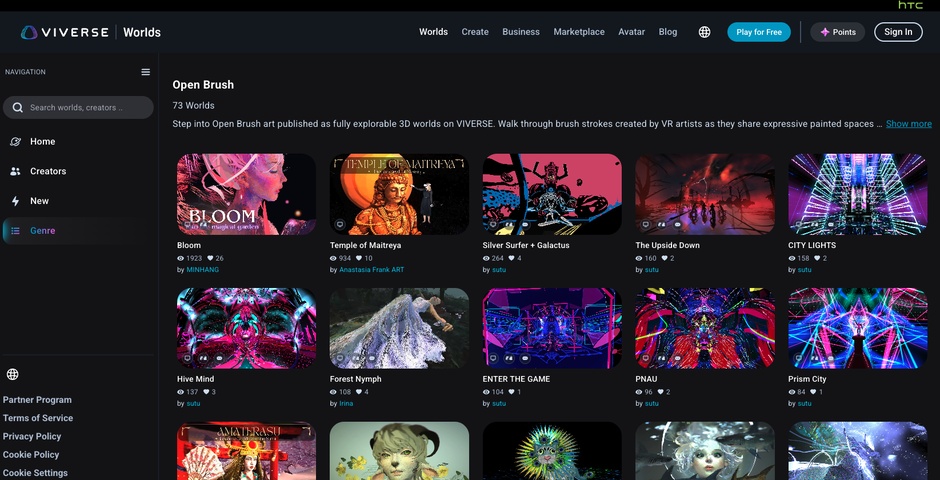
Browser-based VR painting and gallery system combining HTC's VIVERSE social platform with the open-source Open Brush, letting creators paint in 3D and share rooms via URL. 2026 Webby Nominee — Best Immersive Technology Innovation.

James C. Kane
A haunting 15-minute atmosphere-driven narrative game set in 1914 where an artist tries to outrun a storm. Playable via WebXR on Meta Quest browser and VIVERSE without installation. Built with PlayCanvas on the open web standard.
Opus Lab 3D (Łukasz Mirocha)
A browser-based prototype that renders billions of 3D Gaussian splats in real time — an explorable, photorealistic world streamed progressively with no app or install required. Built on the PlayCanvas engine using WebGPU with a WebGL fallback. A single drone-captured scene (~100M splats) is decimated into a 12-level detail pyramid, packed into a streamed spatial-tree format with compressed chunks, and instanced many times to reach billions of splats while a level-of-detail system keeps actively rendered counts in the low millions for smooth real-time performance.